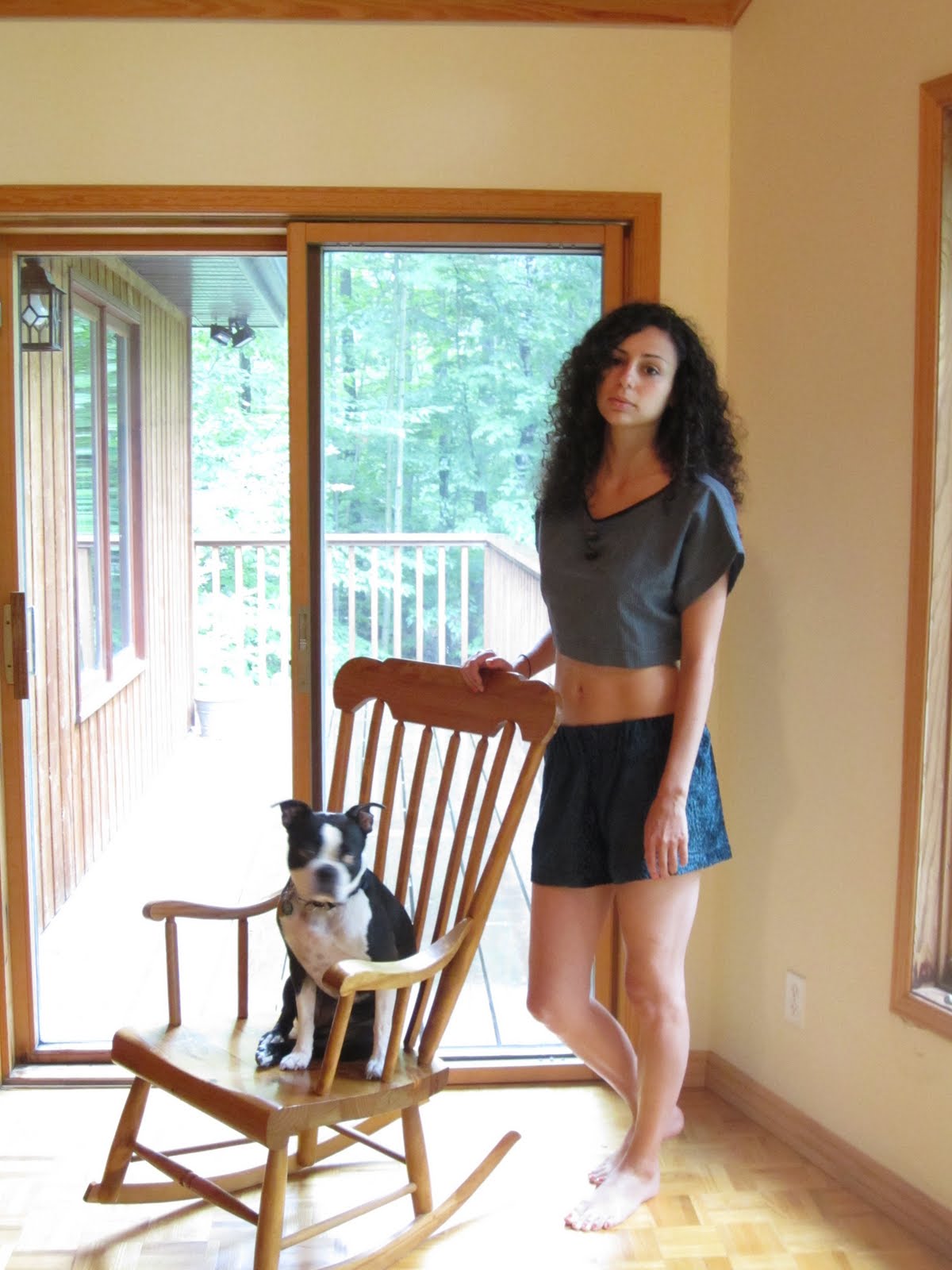
The shop is open today! And just for Halloween, I have put together a table full of headpieces that I made for a photo shoot last year, priced to sell- might be the perfect thing to complete your costume! Come by and take a look-see: 589 Markham Street, 10 am to 6 pm.
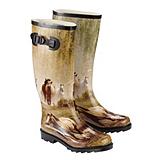
See what happens when you look? I am trying to track down this very attractive pair of rubber boots from Canadian Tire in a size 7- they are pretty cute at $29.99! http://www.canadiantire.ca/search/search_results.jsp for more information.
Hunter Boots: I really want these boots. About three winters ago I also really wanted these boots; I looked into getting a pair then and they were $150 and just couldn't bring myself to spend the money. Then, this past Sunday, I hyped myself up and was going to do it. But still couldn't.
I had a very interesting conversation with my best friend yesterday- the plan was to buy the inset sock for the winter with the Hunter logo on it and wear them with a pair of rain boots from any place.
I looked into that yesterday and decided that the polar fleece sock priced at $39 was also not worth it- I think that I can do better. I am going to work on that, I think that I can do better, make a nicer pair of socks out of wool felt and buy that any rain boot from any place. Now, this might be one of those times where I spend a lot of time and energy making something that is an epic fail, but I will keep you posted with pictures and such...
Although fragrance is a little bit outside the boundaries of clothing, I am coming up on two years of owning two bottles of Channel n 5- one is a spray of eau do toilet (a lower concentration of fragrant oil, thus less expensive); the other is pure perfume (expensive!).
Perfume is to be kept out of direct sunlight in a dry environment, so not the bathroom or on top of your dresser- and even under the best of conditions, they only really last two years.
(I have been called an old lady because of my affection for Channel n 5, but I just can’t help the love! This is the fragrance that launched the modern perfume and to this day, the flowers are grown on one particular farm, harvested and refined all in small town France. Love.)
Pictured above is me at my wedding 3 years ago this week- I made my own dress. I can make yours too. Please contact sara@imadethisforyou.ca for more information.
The amount of fabric that is turned under on a hem depends on the fullness of the garment.
A very straight hem, like that on the black cotton if you see cake skirt pictured above, can be turned up an endless amount- or 2” then another 2” which nicely weights the garment.
If the hem is straight, you can turn it up as little or as much as you like.
A full hem, like that on the gray tonal rose print velvet if you see cake dress pictured above, can only be turned up a little bit- for this particular styling ¼” then another ¼” worked best.
Assess the fullness of the garment you are working with before you attempt an alteration- a very full hem that is turned under too much will buckle and look like a whole lot of terrible!
Both garments are available at the Sara Duke Factory Store Saturdays 10 am to 6 pm, by chance or by appointment anytime- please contact sara@imadethisforyou.ca for more information.
Earlier this fall, I posted about cutting the stay stitching on the vent of your new winter coat- please note this is one of my number one top super pet vexations about fashion! And, sadly, as the weather gets cooler, I see more and more stay stitches that are uncut walking around the city.
Let me take this space and time to remind you to cut that stay stitch out.
On a similar topic, and I should have mentioned this before, winter coats often come with a label that is sewn on to the outside of the sleeve. This tag MUST be removed before wear! Pictured above is an if you see cake label hand tacked onto a sleeve, just a visual, this is the kind of thing that has to be taken off.
This one is a little bit advanced but:
Vogue puts out these really great fitting patterns- basic shapes from which you can develop a very accurate block for yourself or for someone who might want you to make them a little something. Along with the paper pattern, detailed instructions are included addressing measurements, general pattern drafting and sewing techniques.
Grab the size that more or less fits your particular measurements, read through and follow all of the steps then make a quick mock up before getting down and designing- using an inexpensive medium weight woven, non stretch, stripe or plaid/check will show any fitting flaws.
A little bit pricy at $27.50 per envelope, however, Fabricland (www.fabricland.com) sells Vogue patterns at 50% off as far back as I can remember; pattern #1003 for pants and #1004 for a bodice and skirt.
Pins are for thick woven garments! A pin prick on something like a satin weave or into a knit might cause irreparable damage like runs or little holes. Oh no!
In fact, there are two different kinds of sewing machine needles for such particular fabrics- a sharp needle is for wovens where a ballpoint needle is for satins, knits and delicates. The sharp needle has a point which punctures the threads of a fabric; the ballpoint needle is blunt and finds the spaces between the threads of a fabric.
Pins include buttons, straight pins and safety pins- pictured above is a selection of vintage buttons available at the Sara Duke Factory Store on a vintage woven jean jacket. The shoppe is open on Saturdays 10 am to 6 pm, by chance or by appointment anytime- please contact sara@imadethisforyou.ca for more information.
Buttons are made a couple of ways- a shank button will have a loop of plastic, wood, metal or something that creates a bit of space for fabric when a garment is closed. A flat button has two or more holes- when applying (or, commonly, reapplying) a flat button to a garment, a shank must be created. This is accomplished by, after sewing in and out of the all button holes 2 times, winding the thread around the stitches at the base, creating a bit of a stand before tying off.
Most ready to wear clothing comes with extra buttons in a little baggy, or sew on the inside of the garment. If there are no extra buttons and you find yourself button shopping- please remember that buttons have their very own sizing, noted as L for ligne or French for line. Measuring diameter, 40 lignes is equal to one 1 inch.
Pictured above, buttons from my private collection.
Petite does not mean skinny in the fashion industry- petite sizing recognizes the differences in proportion on women who are under 5'4 tall- regular circumferences at the shoulders, bust, waist and hips, but a shorter distance between all of these markers.
Looking at the statistics, this should include most of us being that the average height of women in Canada is 5'3 and a bit. World wide, average height for women is about the same if you do not include Scandinavian countries where women tower over the rest of the world at about 5'6 on average.
Visit a specialty store if 1.) You measure less the 5'4 2.) You find that your blazers and dress shirts bunch up around the waist in the front and back (caused by a short waist/long legs) 3.) You find the crotch of your pants is no where near your crotch (caused by a long waist/short legs)
Pictured above is Judy, built to represent standard proportions. The cross markings are of my own 5'1 frame at the bust, waist and hips. Although Judy and I are a similar girth, I am petite.
Looking at the statistics, this should include most of us being that the average height of women in Canada is 5'3 and a bit. World wide, average height for women is about the same if you do not include Scandinavian countries where women tower over the rest of the world at about 5'6 on average.
Visit a specialty store if 1.) You measure less the 5'4 2.) You find that your blazers and dress shirts bunch up around the waist in the front and back (caused by a short waist/long legs) 3.) You find the crotch of your pants is no where near your crotch (caused by a long waist/short legs)
Pictured above is Judy, built to represent standard proportions. The cross markings are of my own 5'1 frame at the bust, waist and hips. Although Judy and I are a similar girth, I am petite.
Pictured above is a fabulous pair of earrings, designed and made extra super special for the shoppe by a local First Nations artist; glass beads.
It's pretty great- the only set back being that many of the body measurement charts are in metric and although a conversion chart is given, it takes math to change them into inches.
I have just received mine in the mail and am sitting down, putting pencil to paper- I thought that I might share this cool find with you; http://fashionary.org/ for more information.
One more note on fabric construction:
There is leather too. Leather is made by animals all by themselves :) Pictured above is a cow.
So we've got knits, woven and now felted garments. Felt is often made with just raw fibers as opposed to thread- neat, eh? So raw fibers are layered, then heat, water, pressure and mild agitation is used to tangle those fibers together. And, ta-da! Felt!
Let us review- you can have a pull over sweater that is 100% wool because it is a knit; or a 100% wool pair of dress pants with a lovely straight waistband and fly front, maybe some pleats for fit; or even a fedora that is 100% wool that has been felted to fit you head. All of them wool, all different fabric constructions!
Pictured above is a wool jacket is from the "I made this for you."- Sara Duke Fall/Winter 2010 Northern Renaissance collection, shown at Harvard University in Boston last April; full mink pieces and vintage do-da detailing. This jacket and all other bits from the collection are available upon request from the Factory Store (589 Markham Street) on Saturdays 10 am to 6 pm, by chance or by appointment anytime- Sara@imadethisforyou.ca.
Last time there were knits, now there are woven fabrics- these are jeans, jackets and dress shirts. Wovens do not stretch left to right or up and down, only on the bias (on an angle) unless some kind of stretchy fiber is added (spandex). This fabric is construction by tightly holding in place many many threads the length of the fabric (warp threads) and weaving many many other threads left and right (weft or filling threads). Fitted woven garments required functional closures like buttons and zippers.
Pictured above is an all the way black, all the way woven cotton if you see cake skirt with re appropriated vintage fur detail in the front and a functional exposed zipper detail in the back; grommeted twill tape tie. Available now at the shop on Saturdays 10 am to 6 pm, by chance or by appointment anytime- 589 Markham Street, Toronto, Ontario.
Please contact sara@imadethisforyou.ca for an appointment.
Knits are constructed with a serious of loops in an incremental zig-zag formation. There are many different kinds of knits... don't worry about it- knit garments are stretchy and are used for the majority of today's clothing, just remember that mostly jersey is used. T shirts, underwear, socks, toques and sweaters are all knits; basically any garment that stretches to be pulled on, then retains it's shape during wear. Also, knits do not generally include functional closures such as buttons or zippers.
Pictured above is a project that is so so exciting! Silk, cotton blend knit sweater with an antique patch appliqued as a crest by hand (it takes hours). Some of the patches that were found date back to the early 1920's. Love!
Available soon at the "I made this for you." -Sara Duke Factory Store on Saturdays 10 am to 6 pm, by chance or by appointment anytime- 589 Markham Street, Toronto, Ontario.
Please contact sara@imadethisforyou.ca for an appointment.
Pictured below are close up photos, a selection of the great great patches.
Hello there public,
Alright, let's try this! I got some advice today that a blog is not really a blog unless I provide some space for feedback and comments. Here we go, let me know what you think about the content and if you have any fashion questions that you would like me to address.
Thank you!
Love,
Sara Duke
It is coming up on winter and one may notice that the back vent of that brand new winter coat has an X losely sewn at the bottom...
Cut it out!
Often garments are shipped flat in boxes over long distances. This X, or stay stitch, is in place to ensure that the vent does not flip up and over during its long journey. Flippage would create a very nasty crease, given the inevitable changes in temperature and humidity, which would take all kinds of work to get out.
Same goes for welt pockets and pleats, remove the stay stitch before wear.
Pictured above is an illustration of vents and a little definition; and below, a diagram. Pretend that it's the back of that brand new winter coat...
| It is Saturday #2- come find me at 589 Markham Street September 24th, 10 am to 6 pm; or by chance during the week; or by appointment anytime- please contact sara@imadethisforyou.ca. |
Subscribe to:
Comments (Atom)